
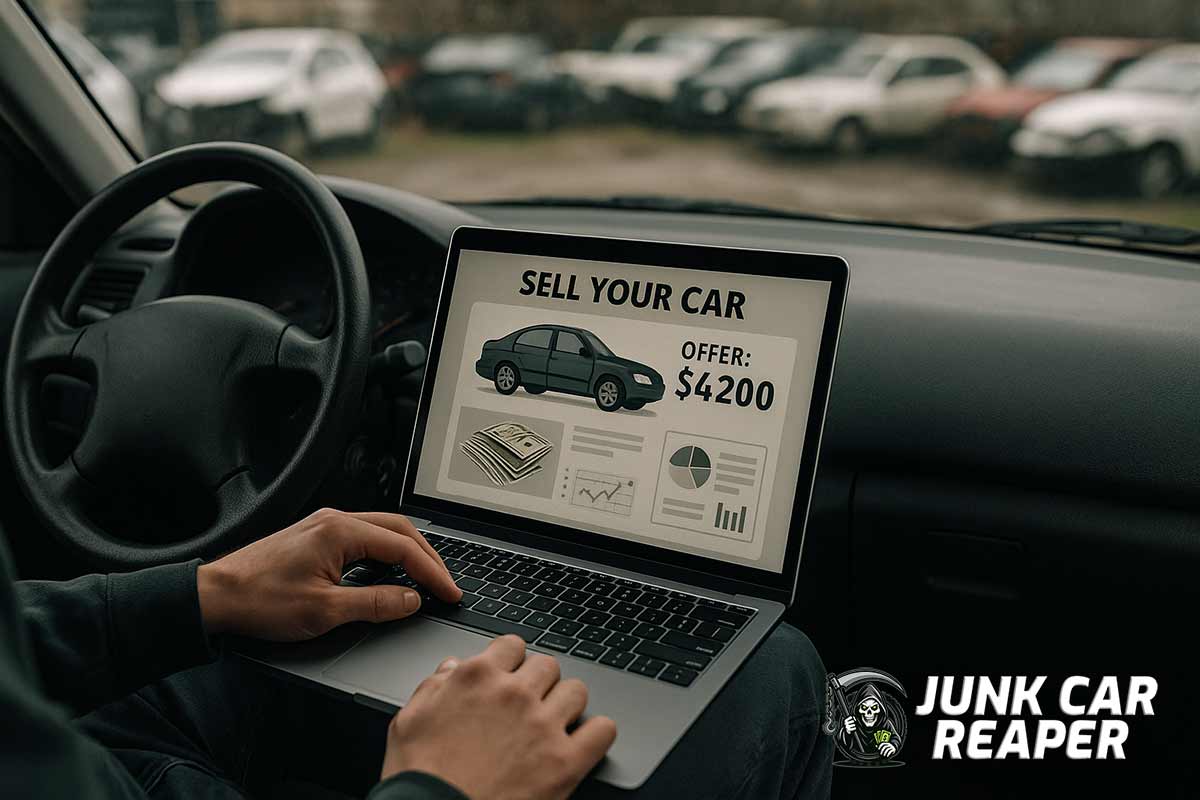
Selling your car online almost always pays more than calling a junkyard.
And it’s not even close.
In most cases, selling your car to a junkyard is the least profitable option. Junkyards price vehicles by weight and scrap metal value only, which means even running cars, newer cars, or cars with valuable parts receive low offers. You will almost always get more money by selling your car online, where multiple buyers compete and value the vehicle for its parts, resale potential, and overall condition, not just its metal.
Online buyers pull offers from multiple junkyards, recyclers, auto auctions, towers, dismantlers, and resellers at the same time. Junkyards, on the other hand, make one offer based only on weight and scrap metal prices.
When you create competition, your price rises. When you call only a junkyard, there is no competition — and you get paid accordingly.
We buy junk cars every single day. I see hundreds of offers, dozens of buyer networks, and massive price differences between what online buyers pay and what local junkyards pay.
Let me show you exactly why.
Why Junkyards Pay the Lowest Amount
Junkyards follow one simple pricing model:
- Vehicle weight × today’s scrap price
That’s it.
They do not price your car based on:
- parts value
- resale demand
- auction potential
- export value
- drivetrain condition
- the value of the vehicle as a whole
Most junkyards want your car because of the metal, not because of the vehicle itself.
What this means for your payout:
- A running Toyota or a non-running Toyota often get the same scrap range.
- A car with new wheels or new tires? Still scrap range.
- A vehicle with valuable parts? Still scrap range.
- Hybrids, SUVs, trucks? Maybe slightly more scrap weight — but still scrap value.
Typical junkyard offers:
$50–$300 for most vehicles, regardless of extra value.
I watch this happen every day. Sellers call a yard, accept the first offer, and leave hundreds on the table because junkyards simply aren’t valuing what makes the car worth more.
Why Selling Your Car Online Almost Always Pays More
Online buyers work completely differently from junkyards.
Instead of one valuation method, they pull multiple bids from:
- auto recyclers
- parts buyers
- dismantlers
- junkyards
- national auction buyers
- export buyers
- local towers
- used-car wholesalers
- salvage rebuilders
Each of these buyers values your vehicle for different reasons:
- Some want the engine
- Some want the transmission
- Some want hybrid batteries
- Some want OEM wheels
- Some want foreign export inventory
- Some want full vehicles for parts
- Some want metal weight
When more buyers want different parts of your car, the value rises.
What this means for your payout:
- Online buyers price based on parts + resale + scrap, not scrap alone.
- Online buyers create real market competition, which raises bids.
- Online buyers see national demand, not one local yard’s demand.
- Online buyers pay more for newer, cleaner, more complete, or running vehicles.
Online buyer payouts typically range:
$300–$1,500+
Much higher than junkyard pricing.
Ruston’s First-Hand Example: How Competition Raises Your Offer
Last week I helped a seller with a 2009 Honda Accord.
- Local junkyard offered $140.
- My online buyer network pulled four bids: $210, $260, $330, and $390.
The seller said, “Why would someone pay that much more?”
Because:
- one buyer needed the engine block
- one needed the doors and hood
- one wanted it for auction stock
- one needed wheels and converter core
Junkyards don’t compete. Networks do.
Competition always raises the price.
Why Online Buyers Value Parts and Resale Potential (and Junkyards Don’t)
Online buyers evaluate your car based on:
- usable parts
- resale channels
- auction interest
- model popularity
- scrap value
- demand for specific components
- total vehicle potential
Junkyards ignore all of this because:
- They rarely rebuild cars
- They rarely inventory parts
- They don’t run national auctions
- They often outsource catalytic converters
- Most yards crush cars within days
Parts online buyers value that junkyards don’t:
- Engine and transmission
- Catalytic converter
- Hybrid batteries
- OEM wheels
- Airbags
- Modules, ECUs, electronics
- Interior components
- Headlights and taillights
- Transfer cases and differentials
Online buyers pay for these because they resell them, not crush them.
A Junkyard Is a Single Buyer — Selling Online Gives You Many
This is the biggest difference.
Junkyard:
You → 1 buyer → 1 price
(usually weight-based)
Online Marketplace:
You → 10+ buyers → bids compete → best offer wins
(parts + resale + scrap)
Even a terrible car becomes more valuable when multiple buyers want different parts of it.
What Sellers Get Wrong About Junkyards
Sellers think:
“If the car barely runs, the junkyard is the only option.”
Not true.
Online buyers purchase:
- non-running cars
- cars with missing converters
- cars with blown engines
- cars with transmission failure
- flood-damaged cars
- high-mileage cars
- wrecked cars
Why?
Because someone in the network always needs something from that car.
A yard only wants the metal.
Why Online Selling Is Also Easier (Not Harder)
Most sellers believe online = more work. That used to be true in the Craigslist era.
Not today.
Modern online buyers provide:
- instant offers
- guaranteed pricing
- free towing
- fast pickup
- clear payment
- no negotiating with strangers
- no showings
- no “buyer flaked” situations
Selling online today is simpler than calling a yard.
Junkyard vs. Online Buyer: Price Comparison
| Factor | Junkyard | Online Buyer |
|---|---|---|
| Pricing Method | Weight only | Parts + resale + scrap |
| Number of Buyers | 1 | Multiple competing buyers |
| Typical Offer | $50–$500 | $300–$1,500+ |
| Offer Guarantee | Rarely | Often guaranteed |
| Towing | Sometimes free | Almost always free |
| Payment Transparency | Low | High |
| Value of Parts | Not considered | Fully considered |
| Condition Sensitivity | Minimal | More value when car runs |
When a Junkyard Might Make Sense
To be fair — junkyards do have a role.
A junkyard may be the best choice if:
- the vehicle is a total loss
- the vehicle has been fully stripped
- it is burned, flooded, or crushed
- it’s missing major structural components
- the vehicle literally has zero usable parts left
In these cases, scrap value is likely all you’ll get, no matter who buys it.
My Advice After Buying Thousands of Junk Cars
If your goal is to get the most money, here’s the truth:
Call an online buyer before you call a junkyard.
Online buyers:
- create competition
- value parts
- value resale potential
- value demand
- value complete cars
- tap into recycling and auction networks
- can pay far more than local yards
Junkyards:
- value metal
- make one offer
- don’t compete
- don’t value parts
- pay machine-weight pricing
If you want the most cash for your car — whether it runs, doesn’t run, or barely hangs together — selling online wins almost every time.
When buyers compete for your car, you win.
